
Functional Anatomy and Biomechanics
Expert-defined terms from the Postgraduate Certificate in Functional Assessment course at HealthCareStudies (An LSPM brand). Free to read, free to share, paired with a professional course.
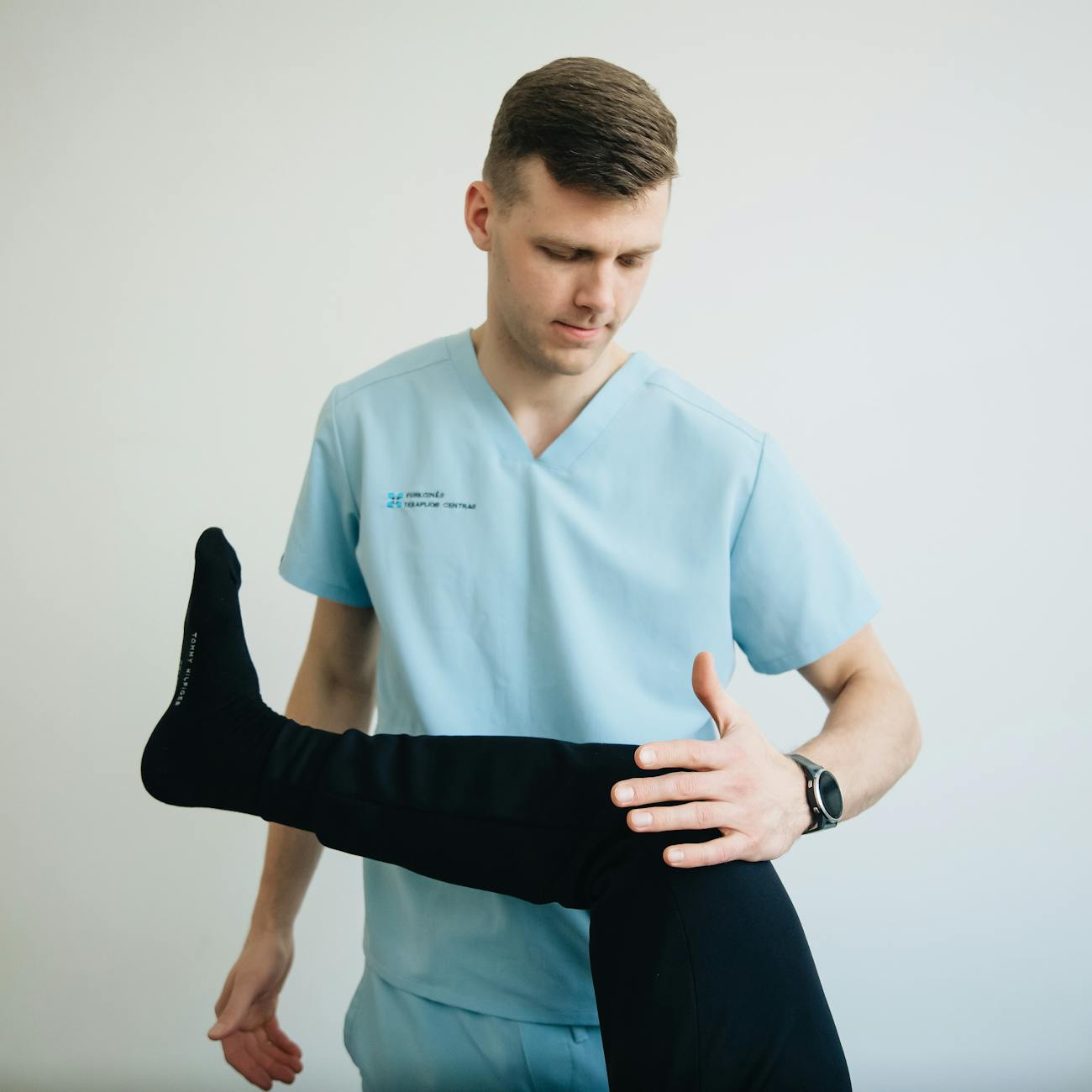
Functional Anatomy and Biomechanics Glossary #
Functional Anatomy and Biomechanics Glossary
A #
A
Acromion Process #
The highest point of the scapula that articulates with the clavicle to form the acromioclavicular joint.
Adduction #
Movement of a body part toward the midline of the body. For example, bringing the arms back to the sides of the body from a raised position is an adduction movement.
Anatomical Position #
The standard position used to describe the location of body parts. The body is upright, facing forward, with the arms at the sides and palms facing forward.
Anterior #
Refers to the front of the body or body part. For example, the pectoralis major muscle is located on the anterior chest wall.
Articulation #
The point where two or more bones meet. Joints are examples of articulations in the body.
B #
B
Biceps Brachii #
A muscle located in the upper arm that has two heads (long head and short head) and is responsible for flexing the elbow joint and supinating the forearm.
Biomechanics #
The study of the mechanical laws relating to the movement or structure of living organisms. In the context of functional assessment, biomechanics focuses on how the body moves and functions in relation to forces acting upon it.
C #
C
Calcaneus #
The largest bone in the foot, commonly referred to as the heel bone.
Concentric Contraction #
Muscle contraction in which the muscle shortens as it generates force. For example, during a bicep curl, the biceps muscle undergoes concentric contraction to lift the weight.
Coronary Plane #
A vertical plane that divides the body into front and back sections. Also known as the frontal plane.
D #
D
Deltoid Muscle #
A muscle located in the shoulder that is responsible for shoulder abduction and flexion.
Distal #
Refers to a location that is farther away from the center of the body or a point of reference. For example, the fingers are distal to the wrist.
Dorsiflexion #
Movement of the ankle joint that involves bringing the top of the foot closer to the shin. This movement is commonly used when walking uphill.
E #
E
Eversion #
Outward movement of the sole of the foot. Eversion typically occurs when the foot rolls outward during walking or running.
Extension #
Movement that increases the angle between two body parts. For example, straightening the elbow joint from a bent position is an extension movement.
External Rotation #
Rotation of a body part away from the midline of the body. For example, rotating the shoulder outward is an example of external rotation.
F #
F
Flexion #
Movement that decreases the angle between two body parts. For example, bending the knee joint is a flexion movement.
Functional Anatomy #
The study of human anatomy in relation to function. It focuses on how the structure of the body supports movement and other bodily functions.
G #
G
Glenohumeral Joint #
The shoulder joint, where the head of the humerus articulates with the glenoid fossa of the scapula. It is a highly mobile joint that allows for a wide range of motion.
H #
H
Hamstring Muscles #
A group of three muscles located at the back of the thigh (biceps femoris, semitendinosus, and semimembranosus) that are responsible for knee flexion and hip extension.
I #
I
Internal Rotation #
Rotation of a body part toward the midline of the body. For example, rotating the shoulder inward is an example of internal rotation.
Isometric Contraction #
Muscle contraction in which the muscle generates force without changing its length. Isometric contractions are commonly used to stabilize joints.
J #
J
Joint #
The point where two or more bones meet in the body. Joints allow for movement and provide stability to the skeleton.
K #
K
Kinematics #
The study of the motion of bodies without considering the forces that cause the motion. It involves describing the position, velocity, and acceleration of body parts.
L #
L
Lateral #
Refers to the side of the body or body part. For example, the lateral head of the triceps brachii muscle is located on the outer side of the arm.
Ligament #
A fibrous connective tissue that connects bones to other bones in a joint. Ligaments provide stability to joints and prevent excessive movement.
M #
M
Medial #
Refers to the middle or inner side of the body or body part. For example, the medial head of the gastrocnemius muscle is located on the inner side of the calf.
N #
N
Neutral Position #
The position of a joint where there is no significant movement or stress placed on the joint. This position is often used as a reference point for assessing joint function.
O #
O
Oblique Plane #
A plane that is diagonal or slanted in orientation. The oblique plane is not parallel to any of the cardinal planes (sagittal, frontal, transverse).
P #
P
Patella #
Also known as the kneecap, the patella is a small bone located in front of the knee joint. It plays a crucial role in knee extension and stability.
Posterior #
Refers to the back of the body or body part. For example, the trapezius muscle is located on the posterior aspect of the upper back.
Q #
Q
Quadriceps Muscles #
A group of four muscles located at the front of the thigh (rectus femoris, vastus lateralis, vastus medialis, vastus intermedius) that are responsible for knee extension.
R #
R
Range of Motion (ROM) #
The extent of movement that a joint can perform in various directions. Range of motion is an important measure of joint function and flexibility.
S #
S
Sagittal Plane #
A vertical plane that divides the body into left and right sections. Movements that occur in the sagittal plane include flexion and extension.
Scapula #
Also known as the shoulder blade, the scapula is a flat triangular bone located on the posterior aspect of the shoulder. It plays a crucial role in shoulder movement and stability.
T #
T
Transverse Plane #
A horizontal plane that divides the body into upper and lower sections. Movements that occur in the transverse plane include rotation.
U #
U
Ulna #
One of the two bones of the forearm, located on the medial side. The ulna articulates with the humerus and forms the elbow joint.
V #
V
Vertebral Column #
Also known as the spine, the vertebral column is a series of vertebrae that extends from the skull to the pelvis. It provides support and protection to the spinal cord.
W #
W
Wrist Flexors #
Muscles located on the anterior aspect of the forearm that are responsible for flexing the wrist joint. Examples include the flexor carpi radialis and flexor carpi ulnaris.